Temminck’s Tragopan (Tragopan temminckii): The Crimson Jewel of the Mountain Forest
Among the world’s most breathtaking galliformes, few command attention quite like the Temminck’s Tragopan (Tragopan temminckii). Often referred to as one of the most visually striking members of the pheasant family, this species combines extraordinary beauty, fascinating natural history, and a well-earned place in serious aviculture.
Named after Dutch zoologist Coenraad Jacob Temminck, this remarkable “horned pheasant” is widely regarded by many breeders as one of the most practical and rewarding tragopan species to maintain—while still offering one of the most dramatic courtship displays in the bird world.
Scientific Classification
- Common Name: Temminck’s Tragopan
- Scientific Name: Tragopan temminckii
- Order: Galliformes
- Family: Phasianidae
Temminck’s is one of only five tragopan species globally, a unique group often called “horned pheasants” due to the male’s inflatable blue horns and vividly colored lappet displayed during breeding rituals.
Physical Description: A Living Work of Art
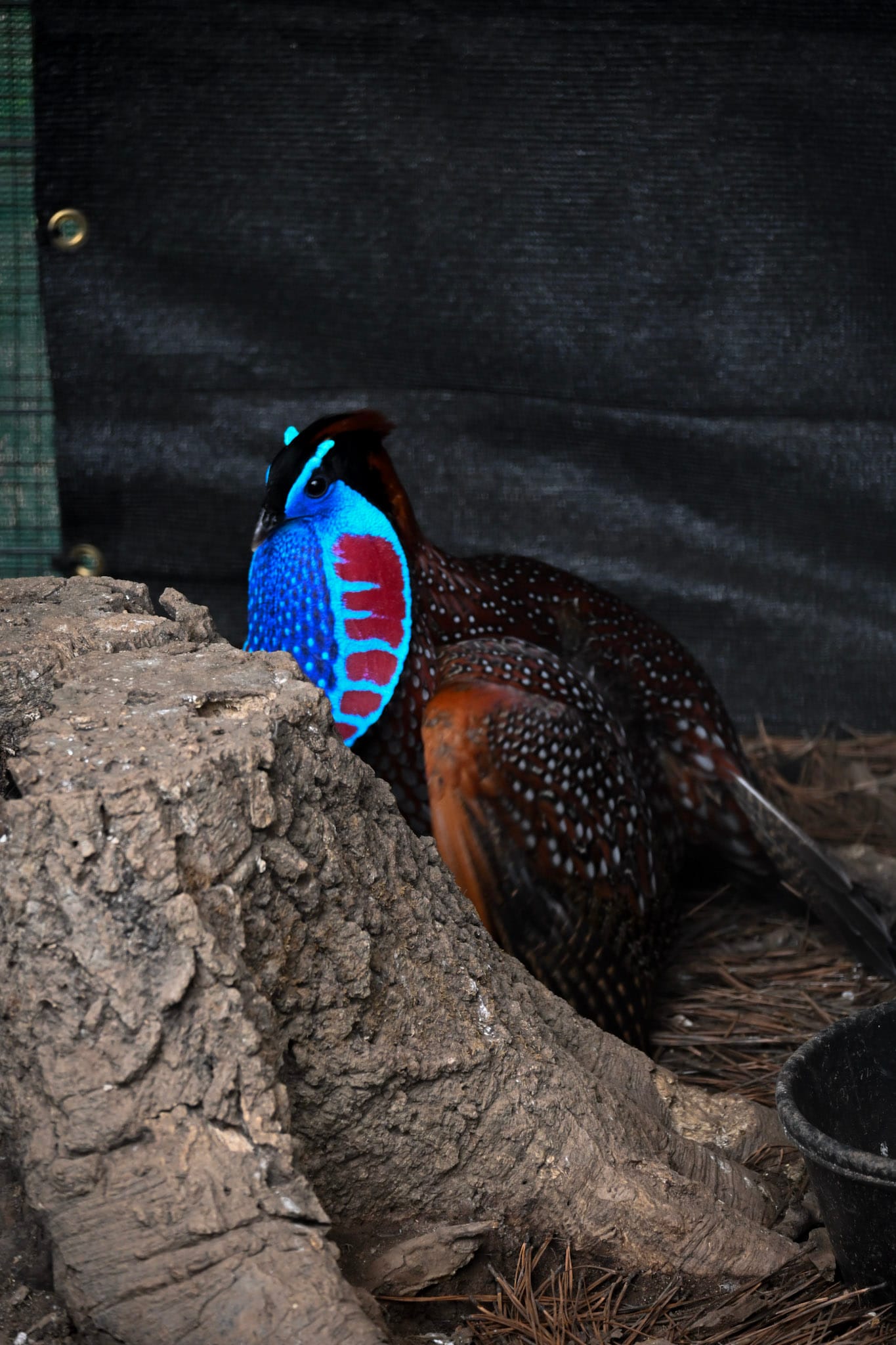
The male Temminck’s Tragopan is unmistakable:
- Rich crimson-red to fiery orange plumage
- White ocelli (spotted patterning) across the body
- Electric blue facial skin
- Inflatable cobalt-blue throat lappet
- Erectable fleshy blue “horns” during display
Females are dramatically different—cryptically colored in mottled browns, buffs, and grays for camouflage while nesting. This sexual dimorphism is essential for survival in dense montane forests.
Native Range & Habitat
Temminck’s Tragopan inhabits mountainous forest systems across:
- Northeastern India
- Northern Myanmar
- Central and southern China
- Northwestern Vietnam
They favor cool, humid highland forests with dense understory—especially bamboo, rhododendron, mixed conifer-deciduous forests, and shrubby slopes, typically between roughly 1,800–3,600 meters depending on season. Seasonal elevation shifts are common, moving lower in winter.
Behavior & Ecology
Unlike many galliformes, tragopans are notably arboreal.
Key Behavioral Facts:
- Roost in trees
- Often nest above ground in trees or abandoned nests
- Usually found singly or in monogamous pairs
- Diet includes berries, shoots, bamboo leaves, seeds, moss, insects, and vegetation
- Chicks are highly precocial and can fly quickly after hatching
Their tree-nesting habits are especially unusual among pheasants and heavily influence captive management.
Conservation Status in the Wild
IUCN Status: Least Concern (LC)
Temminck’s Tragopan remains the most secure of the tragopans globally due to its wide range and relatively strong numbers. However, “Least Concern” does not mean “no concern.”
Primary Threats:
- Deforestation
- Habitat fragmentation
- Fuelwood harvesting
- Local hunting pressure
Population trends in some areas are believed to be declining due to ongoing habitat degradation, particularly loss of understory vegetation crucial for cover and feeding.
Temminck’s Tragopan in Aviculture
For serious pheasant and conservation breeders, Temminck’s Tragopan is often considered the gateway tragopan species.
Why They’re Valued:
1. Hardier than many tragopan species
They are generally more forgiving than Cabot’s or Blyth’s.
2. Strong reproductive potential
Temminck’s are often more prolific layers than some other tragopans.
3. Excellent parenting instincts
Hens may brood naturally and can be strong mothers.
4. Stunning display value
Few aviary birds rival the breeding display of a mature male.
Captive Care Considerations
Aviary Design:
Because they are forest and arboreal birds:
- Spacious planted aviaries are ideal
- Shade is critical
- Elevated roosts and nest boxes are strongly recommended
- Cooler climates are generally better tolerated than extreme heat
Climate:
They tend to handle cold better than excessive heat, making shade, ventilation, and summer cooling important in warmer regions.
Pairing:
Most breeders recommend true pairs, as tragopans are generally monogamous and can experience aggression issues in improper social setups.
Breeding Facts
- Typical clutch: 3–5 eggs (sometimes more)
- Incubation: ~28 days
- Eggs: Speckled, pheasant-like
- Chicks: Fast-developing, highly active, early fliers
Because chicks can fly almost immediately, brooders must be escape-proof—an often-overlooked but critical detail.
Conservation Through Aviculture
Temminck’s Tragopan demonstrates one of aviculture’s greatest strengths: preserving healthy, genetically viable populations of extraordinary species while fostering education and appreciation.
While this species is not currently among the most endangered tragopans, responsible aviculture:
- Maintains genetic reservoirs
- Reduces pressure on wild populations
- Educates the public
- Builds husbandry knowledge for more threatened relatives
For wild-type focused breeders, maintaining pure, healthy Temminck’s bloodlines represents both stewardship and legacy.
Final Thoughts
Temminck’s Tragopan is more than just a beautiful bird—it is a flagship species for mountain forest biodiversity, ethical aviculture, and the incredible diversity within Phasianidae.
For breeders, conservationists, and enthusiasts alike, this species offers the rare combination of:
Beauty. Manageability. Biological uniqueness. Conservation value.
In many ways, Temminck’s Tragopan perfectly represents where passion meets preservation.